Here’s how they differ on the metrics that actually matter for college readiness:
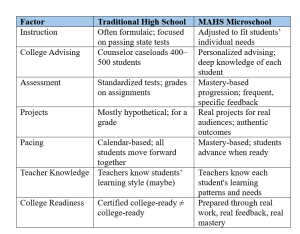
The bottom line: Traditional high schools are designed for efficiency and standardization. Microschools are designed for mastery and college readiness. When students arrive at college, MAHS graduates have already experienced what college-level work looks like—real projects, real feedback, real thinking. They don’t need to catch up; they’re already ahead.
When choosing a college-prep microschool, look for these markers of actual college readiness:
Strong writing instruction grounded in real writing, not test prep. College success hinges on being able to write clearly and think on paper. The best college-prep microschools teach writing through authentic projects and real audiences, not formulaic essays or test-taking strategies.
A track record with college outcomes. Ask: Do graduates get into colleges? Do they thrive there? Schools should be able to show specific data on college acceptance, retention, and success.
Mastery-based progression, not seat time. College doesn’t care how many hours you spent in a classroom. It cares whether you can think independently, write clearly, and learn on your own. Microschools that use mastery-based progression prepare students for actual college demands.
Real-world projects that build college-ready skills. Students should be working on projects that require critical thinking, research, writing, and collaboration—the exact skills colleges expect.
At MAHS, we’re explicitly designed for college success. Our students graduate with strong writing skills, experience working on real projects, and the ability to think independently. Our founder, Tonya Whitaker, teaches freshman composition in the University of Texas system. She currently uses mastery-based, real-writing instruction as a first year writing professor. We apply those same principles at the high school level to prepare students for college before they arrive.
We do not accept TEFA funding. However, we offer several flexible payment options for families to pay tuition. Contact us to discuss your options.
Mastery-based learning means students advance when they’ve actually mastered a skill, not when the calendar says so. Microschools like MAHS support this in ways traditional schools can’t:
Small class sizes enable personalized pacing. With 15 maximum students in the entire school, teachers see exactly where each student is struggling and can adjust support in real time. No student gets left behind waiting for the group, and no student gets bored waiting for everyone else to catch up.
Real-time feedback replaces grades. Instead of waiting weeks for a graded essay, students get specific, actionable feedback throughout the learning process. They revise, get more feedback, and experience what mastery actually feels like—not just a grade on a final submission.
Time is flexible; outcomes are not. If a student needs three weeks to master a concept, they get three weeks. If another student masters it in five days, they move forward. The timeline is flexible; the standard is fixed.
Projects are real, not simulated. Students work on authentic projects for real audiences—published writing, community proposals, digital archives. This raises the stakes naturally. The work matters because it actually matters, not because it’s graded.
Low-stakes practice replaces high-stakes testing. Learning happens through frequent, low-pressure practice with immediate feedback, not cramming for tests. This aligns with how adolescent brains actually learn.
Mastery-based learning isn’t a buzzword; it’s how we structure every day. Your teen moves forward when they’re ready, not when the system decides they should
The best mastery-based microschool for your teen should have these characteristics:
A clear definition of mastery. The school should articulate what “mastered” means in each subject and skill. It’s not vague; it’s specific and measurable.
Flexible timelines with fixed standards. Students move at their own pace, but the standard for advancement is the same for everyone. Your student isn’t competing against peers; they’re working toward mastery.
Frequent formative assessment and feedback. Learning happens through low-stakes practice with immediate feedback, not high-stakes testing. Teachers give feedback throughout the learning process so students can improve before final assessment.
Real projects with real audiences. Mastery-based learning is most powerful when students apply their skills to authentic work. Projects should require students to think, create, and engage with real-world problems or audiences.
Teacher-student relationships that enable personalization. Teachers need to know students well enough to identify learning gaps, provide targeted feedback, and adjust support. This requires small class sizes and time.
A track record of student success. Ask about graduate outcomes. Are students college-ready? Do they succeed in college? Can the school show data?\